Oh I have a hunch she was expecting this, and why they robbed the “coffins” for the floating cams first. Everyone is going to be freaked out when the cams go haywire and then the cavalry will show up.
When you’re a writer you tend to pay attention not just to words but the way people say them, and unless you’re some kind of filthy, futile prescriptivist you also should have a fascination with the way that such things evolve over time. Don’t get me wrong, Strunk and White have their place in terms of setting up some common protocols for communication, but outside of formal settings I think it’s an enormous mistake to get hung up on split infinitives and sentence-ending prepositions so long as the meaning remains clear. Writers can certainly benefit from editing, but they also need room to play. And use fragments. Sometimes.
However, back to the subject of verbal evolution, of which one of my favorite examples is the English farewell term of “bye.” The meaning has not changed but the original form was “God be with ye,” which then eventually contracted to “God bye ye,” then “Godb(w)ye,” then our modern “goodbye,” and finally down to the monosyllable noted above.
Similar to this, in Spanish there is still the phrase “vaya con Dios” (literally translated as “[you] go with God”) but that’s a mouthful and “adiós” is much more common. Some argue that the latter has never had anything to do with deities but considering the very similar French “adieu” and that the original Latin for “to God” or “by God” would have been “ad deus,” I don’t buy it.
In any case, were I to try to invent my own language I would no doubt fail drastically, but it would be hard to go wrong by having my informal farewell be short, to the point, and either referencing or deriving from a reference to deity or some form of “until we meet again.” The latter is what “hasta luego” and “auf wiedersehen” basically translate to, in case you were wondering.
This sort of “phrase archaeology” is a really good thing to practice if you’re coming up with slang, though. Spoken language is where evolution of language take place first, and in general spoken language likes to simplify for efficiency’s sake. Today’s slang then becomes tomorrow’s prescription.






4 thoughts on “559 – Words To Die By”
Scarsdale
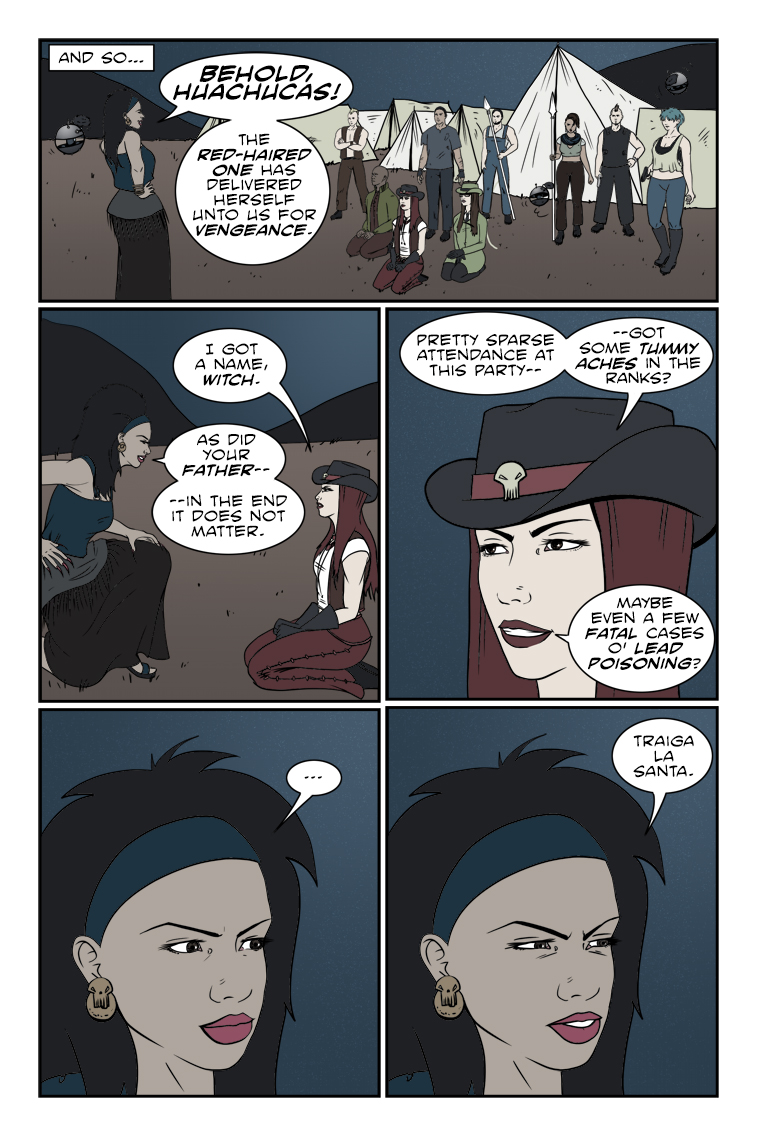
Ha! I love the “o` lead poisoning” comment, I’ve used it to run kids off there were trying to set our hay bales on fire 😉
Scarsdale
Never mind that my shotgun had rock salt loads 😀
ConcordBob
Finally the two female leads are face-to-face! Now if Rosa can swoop in to save Suzie….
Scarsdale
Oh I have a hunch she was expecting this, and why they robbed the “coffins” for the floating cams first. Everyone is going to be freaked out when the cams go haywire and then the cavalry will show up.
Latest Comics
#1. EPISODE ONE
68 Sep 24, 2009
Latest Chapters
Episode 22
Episode 21
Episode 20
Episode 19
Episode 18
Episode 17
559 – Words To Die By
In Suzie's defense, it's not like they were going to get out of this by being nice.
Watch your language…
When you’re a writer you tend to pay attention not just to words but the way people say them, and unless you’re some kind of filthy, futile prescriptivist you also should have a fascination with the way that such things evolve over time. Don’t get me wrong, Strunk and White have their place in terms of setting up some common protocols for communication, but outside of formal settings I think it’s an enormous mistake to get hung up on split infinitives and sentence-ending prepositions so long as the meaning remains clear. Writers can certainly benefit from editing, but they also need room to play. And use fragments. Sometimes.
However, back to the subject of verbal evolution, of which one of my favorite examples is the English farewell term of “bye.” The meaning has not changed but the original form was “God be with ye,” which then eventually contracted to “God bye ye,” then “Godb(w)ye,” then our modern “goodbye,” and finally down to the monosyllable noted above.
Similar to this, in Spanish there is still the phrase “vaya con Dios” (literally translated as “[you] go with God”) but that’s a mouthful and “adiós” is much more common. Some argue that the latter has never had anything to do with deities but considering the very similar French “adieu” and that the original Latin for “to God” or “by God” would have been “ad deus,” I don’t buy it.
In any case, were I to try to invent my own language I would no doubt fail drastically, but it would be hard to go wrong by having my informal farewell be short, to the point, and either referencing or deriving from a reference to deity or some form of “until we meet again.” The latter is what “hasta luego” and “auf wiedersehen” basically translate to, in case you were wondering.
This sort of “phrase archaeology” is a really good thing to practice if you’re coming up with slang, though. Spoken language is where evolution of language take place first, and in general spoken language likes to simplify for efficiency’s sake. Today’s slang then becomes tomorrow’s prescription.
More on this topic next week.
Calendar
BlueSky Latest Posts
Writer’s Blog Archives