It’s been a while, so let me ask: Did we get a reason for him to WANT Susie dead? Not to backseat, but if we didn’t, I’m worried were about to move into “Stupid Evil” territory. Now, stupid happens, don’t get me wrong. It’s not bad storytelling for that to be the case here.
You’ve just done a good job NOT having that be a driving factor, so the “Kill off the stars of my successful reality TV show.” seems shortsighted, otherwise. Oh, I guess I could be mistaken about the in-story reality TV show’s success. Like, if the company behind them is losing money, or they think a change in management at the ranch would make the whole thing more popular/profitable, then I can see the above scenario happening as well.
I REALLY think I’m just forgetting something important, but that I don’t have time to deep dive to remind me of, hence the comment. >_<
It certainly has been stretched out over quite a while, but there have definitely been hints from quite near the beginning that whoever is running the reality TV show definitely wants her dead.
Yeah it’s fair to not remember since it’s been a hot minute (many, many minutes) but if you feel like a refresher the most relevant bits would be the beginning of Episode 8 and the end of Episode 15. We haven’t explicitly spelled out exactly what The Exec means by his “side hustle” or who was on the other end of that phone call, though.
I’m hoping that when the whole thing is eventually available it will make sense, or at least enough sense to have hung this narrative on.
Otaku
Thanks for the replies, Deoxy and Clint. Yeah, I’d totally forgotten about those things. Good to know!
There’s still 3-5 people on her side that might be planning something. This guy is a megalomaniac with a god complex, so letting him think he’s the sharpest tool in the shed sets him up for a fall. Everything depends on those cameras, and I suspect their little stop over by the charging coffins had something to do with her actual plan, not the one the a-hole thinks it is.
Really enjoyed the opening of Zombie Ranch. I like the combination of the western setting with the zombie concept, it gives the story a really distinctive atmosphere. I’m a freelance illustrator and animator, and I’d be interested in seeing how some of these scenes could translate into motion, especially as a short animated teaser or character scene.
If you’re ever interested in something like that, you can reach me here:
As you might imagine, it’s a pet peeve of mine when comics are categorically dismissed as an art form or as having any merit beyond the purely commercial. This attitude has seemed to soften in the 21st Century with works like Watchmen earning literary recognition, but traces of it linger, as I was reminded just recently by this article in the Irish Times.
The dismissed parties in this case are not comics authors, they are authors of prose crime fiction, but the details are all too familiar. In the midst of a sprawling essay by a former professor of English at a prestigious university praising one of his unsung proteges of creative writing, there is a sudden, almost non-sequitur lashing out:
“But authors make mistakes, too. Very few non-commercial writers know how to successfully advance their careers. Michael was no exception. He changed agents, publishers, gave up writing short stories – a critical mistake in this country, if you want to continue to be noticed as a literary writer – and attempted to jump into the crime genre to entice the vagrant reader. If bestsellers were easy to write there would be more of them. Michael, unfortunately, had, has, too much talent to succeed as a crime writer. He doesn’t possess the fatal lack of talent required. He asks too much of a reader. America really doesn’t possess enough of a literary culture anymore to maintain a writer like Michael.”
The article I linked above was a response to this portion, which in the original essay is truthfully only one paragraph out of many. And yet, what a terrible, bitter thing to write. What a sadly unchallenged view it still is, in certain circles of academia, that entire genres of fiction are somehow inherently inferior, a view often based in a few bad examples or just outright ignorance based on nothing but inherited or imagined prejudice.
And as I thought about it, I thought how that seemed eerily familiar.
Dismissal of genres (or in the case of comics, an entire medium) as inferior is nothing more or less than literary bigotry, with no more merit or justice to it than if you were to similarly discount say, certain minorities. Or women. Speaking of which–just in case you think I’m reaching with that comparison–the original essay had this to say as well regarding Michael Collins’ career success problems:
“One difficulty is that Michael, unlike the three writers mentioned above, is not a Dead White Male (a category anathema in US literature departments for the last 30 years), but a Live White Male, not a demographic entity that is much in fashion these days. Though globalised in actuality, Michael is not globalised by background or genetics.”
As a Live White Male myself, I will admit to not being much in fashion — at least in the sense that I love aloha shirts to what is, arguably, a fault, and have taken to wearing a pith helmet in the rain. But I halt well short of any implications that I am being unfairly passed over, and were it me being referenced in the paragraph above I would have to thank the professor for his efforts on my behalf, but ask him to stop “helping.”
Anyhow, I’m not so bitter yet as to apply Sturgeon’s Law to people, but where literary criticism is concerned, literary bigotry is easily avoided by remembering that ninety percent of all fiction is crud, regardless of medium, genre, source or marketability. And keep in mind that they all also have that remaining ten percent which justifies the rest.



9 thoughts on “558 – Cotton Clad Calamity”
Raznaak
Yup, he’s a bastard XD
Dr. Norman (not a real doctor)
Are those pajamas available in XXXL in the gift shop?
Otaku
It’s been a while, so let me ask: Did we get a reason for him to WANT Susie dead? Not to backseat, but if we didn’t, I’m worried were about to move into “Stupid Evil” territory. Now, stupid happens, don’t get me wrong. It’s not bad storytelling for that to be the case here.
You’ve just done a good job NOT having that be a driving factor, so the “Kill off the stars of my successful reality TV show.” seems shortsighted, otherwise. Oh, I guess I could be mistaken about the in-story reality TV show’s success. Like, if the company behind them is losing money, or they think a change in management at the ranch would make the whole thing more popular/profitable, then I can see the above scenario happening as well.
I REALLY think I’m just forgetting something important, but that I don’t have time to deep dive to remind me of, hence the comment. >_<
Deoxy
It certainly has been stretched out over quite a while, but there have definitely been hints from quite near the beginning that whoever is running the reality TV show definitely wants her dead.
But I certainly don’t recall any reason why.
Clint
Yeah it’s fair to not remember since it’s been a hot minute (many, many minutes) but if you feel like a refresher the most relevant bits would be the beginning of Episode 8 and the end of Episode 15. We haven’t explicitly spelled out exactly what The Exec means by his “side hustle” or who was on the other end of that phone call, though.
I’m hoping that when the whole thing is eventually available it will make sense, or at least enough sense to have hung this narrative on.
Otaku
Thanks for the replies, Deoxy and Clint. Yeah, I’d totally forgotten about those things. Good to know!
Evervigilant
Seems about time for the two people who aren’t there to make a surprise entrance as the ace Susie didn’t even know she had.
Scarsdale
There’s still 3-5 people on her side that might be planning something. This guy is a megalomaniac with a god complex, so letting him think he’s the sharpest tool in the shed sets him up for a fall. Everything depends on those cameras, and I suspect their little stop over by the charging coffins had something to do with her actual plan, not the one the a-hole thinks it is.
lyra
Really enjoyed the opening of Zombie Ranch. I like the combination of the western setting with the zombie concept, it gives the story a really distinctive atmosphere. I’m a freelance illustrator and animator, and I’d be interested in seeing how some of these scenes could translate into motion, especially as a short animated teaser or character scene.
If you’re ever interested in something like that, you can reach me here:
IG: eve_verse_
Email: [contact.lilaclines@gmail.com](mailto:contact.lilaclines@gmail.com)
Discord: Lyralilac_
Latest Comics
#380. 365 – The Philosopher’s Tone
19 Jan 24, 2018
#379. 364 – In Memoriam
20 Jan 17, 2018
#378. 363 – Broken Records
21 Jan 10, 2018
#377. 362 – Civilian Investigation
28 Dec 13, 2017
#376. 361 – Zeke, Interrupted
28 Dec 06, 2017
#375. 360 – Baiting A Trap
27 Nov 29, 2017
#374. 359 – The Z-Roll
21 Nov 22, 2017
#373. 358 – Gut Feelings
19 Nov 15, 2017
#372. 357 – Monsters Watching Monsters
17 Nov 08, 2017
#371. 356 – A Screwed Up Shindig
25 Nov 01, 2017
#370. 355 – Smoker’s Remorse
23 Oct 25, 2017
#369. 354 – Deathbed Confessional
31 Oct 18, 2017
#368. 353 – Prompt Failure
26 Oct 11, 2017
#367. 352 – Ill Humor
16 Oct 04, 2017
#366. 351 – Dying On The Inside
24 Sep 20, 2017
#365. 350 – Threats And Whispers
17 Sep 13, 2017
#364. 349 – Liberties And Justice
23 Sep 06, 2017
#363. 348 – Don’t Mess
19 Aug 30, 2017
#362. 347 – Yesteryear’s Special
20 Aug 23, 2017
#361. 346 – Dramatic Irony
25 Aug 16, 2017
Latest Chapters
Episode 22
Episode 21
Episode 20
Episode 19
Episode 18
Episode 17
558 – Cotton Clad Calamity
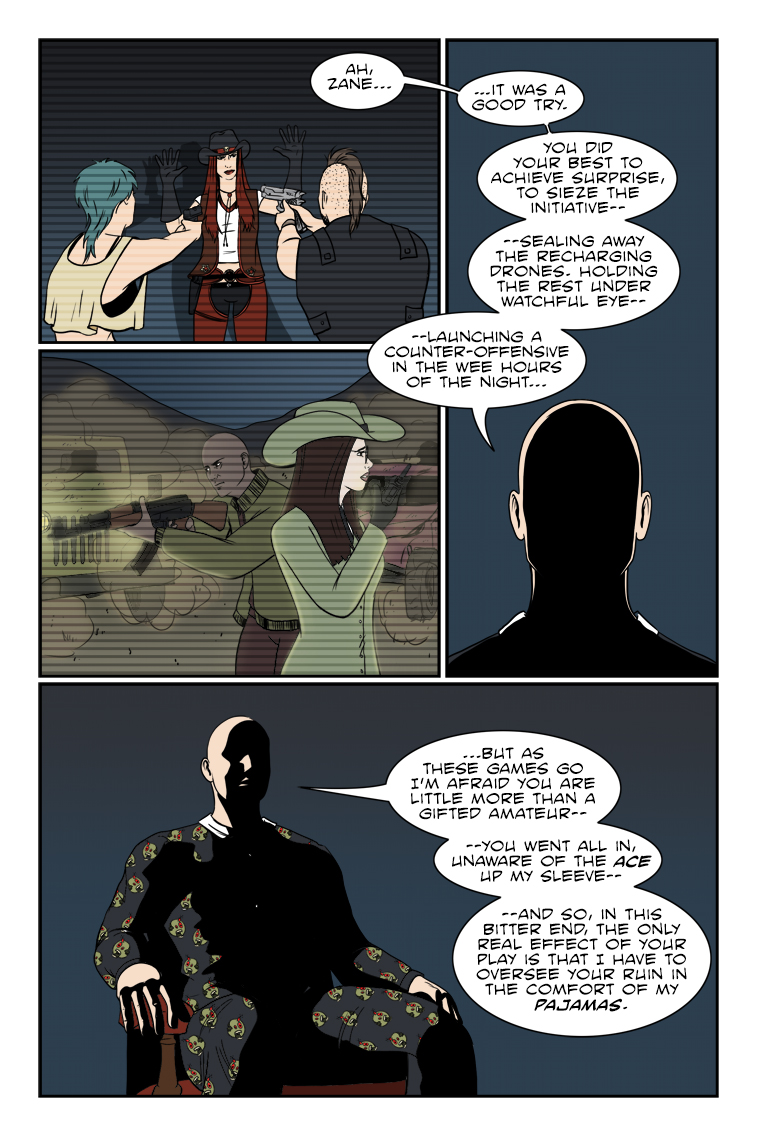
What would you call this? Armchair assassination? Merk-from-home?
Well, Suzie ain't dead (or undead) quite yet, so we'll just have to see if his gloating is justifiable.
Putting the -ism in literary criticism.
As you might imagine, it’s a pet peeve of mine when comics are categorically dismissed as an art form or as having any merit beyond the purely commercial. This attitude has seemed to soften in the 21st Century with works like Watchmen earning literary recognition, but traces of it linger, as I was reminded just recently by this article in the Irish Times.
The dismissed parties in this case are not comics authors, they are authors of prose crime fiction, but the details are all too familiar. In the midst of a sprawling essay by a former professor of English at a prestigious university praising one of his unsung proteges of creative writing, there is a sudden, almost non-sequitur lashing out:
“But authors make mistakes, too. Very few non-commercial writers know how to successfully advance their careers. Michael was no exception. He changed agents, publishers, gave up writing short stories – a critical mistake in this country, if you want to continue to be noticed as a literary writer – and attempted to jump into the crime genre to entice the vagrant reader. If bestsellers were easy to write there would be more of them. Michael, unfortunately, had, has, too much talent to succeed as a crime writer. He doesn’t possess the fatal lack of talent required. He asks too much of a reader. America really doesn’t possess enough of a literary culture anymore to maintain a writer like Michael.”
The article I linked above was a response to this portion, which in the original essay is truthfully only one paragraph out of many. And yet, what a terrible, bitter thing to write. What a sadly unchallenged view it still is, in certain circles of academia, that entire genres of fiction are somehow inherently inferior, a view often based in a few bad examples or just outright ignorance based on nothing but inherited or imagined prejudice.
And as I thought about it, I thought how that seemed eerily familiar.
Dismissal of genres (or in the case of comics, an entire medium) as inferior is nothing more or less than literary bigotry, with no more merit or justice to it than if you were to similarly discount say, certain minorities. Or women. Speaking of which–just in case you think I’m reaching with that comparison–the original essay had this to say as well regarding Michael Collins’ career success problems:
“One difficulty is that Michael, unlike the three writers mentioned above, is not a Dead White Male (a category anathema in US literature departments for the last 30 years), but a Live White Male, not a demographic entity that is much in fashion these days. Though globalised in actuality, Michael is not globalised by background or genetics.”
As a Live White Male myself, I will admit to not being much in fashion — at least in the sense that I love aloha shirts to what is, arguably, a fault, and have taken to wearing a pith helmet in the rain. But I halt well short of any implications that I am being unfairly passed over, and were it me being referenced in the paragraph above I would have to thank the professor for his efforts on my behalf, but ask him to stop “helping.”
Anyhow, I’m not so bitter yet as to apply Sturgeon’s Law to people, but where literary criticism is concerned, literary bigotry is easily avoided by remembering that ninety percent of all fiction is crud, regardless of medium, genre, source or marketability. And keep in mind that they all also have that remaining ten percent which justifies the rest.
Calendar
BlueSky Latest Posts
Writer’s Blog Archives