It’s been a while, so let me ask: Did we get a reason for him to WANT Susie dead? Not to backseat, but if we didn’t, I’m worried were about to move into “Stupid Evil” territory. Now, stupid happens, don’t get me wrong. It’s not bad storytelling for that to be the case here.
You’ve just done a good job NOT having that be a driving factor, so the “Kill off the stars of my successful reality TV show.” seems shortsighted, otherwise. Oh, I guess I could be mistaken about the in-story reality TV show’s success. Like, if the company behind them is losing money, or they think a change in management at the ranch would make the whole thing more popular/profitable, then I can see the above scenario happening as well.
I REALLY think I’m just forgetting something important, but that I don’t have time to deep dive to remind me of, hence the comment. >_<
It certainly has been stretched out over quite a while, but there have definitely been hints from quite near the beginning that whoever is running the reality TV show definitely wants her dead.
Yeah it’s fair to not remember since it’s been a hot minute (many, many minutes) but if you feel like a refresher the most relevant bits would be the beginning of Episode 8 and the end of Episode 15. We haven’t explicitly spelled out exactly what The Exec means by his “side hustle” or who was on the other end of that phone call, though.
I’m hoping that when the whole thing is eventually available it will make sense, or at least enough sense to have hung this narrative on.
Otaku
Thanks for the replies, Deoxy and Clint. Yeah, I’d totally forgotten about those things. Good to know!
There’s still 3-5 people on her side that might be planning something. This guy is a megalomaniac with a god complex, so letting him think he’s the sharpest tool in the shed sets him up for a fall. Everything depends on those cameras, and I suspect their little stop over by the charging coffins had something to do with her actual plan, not the one the a-hole thinks it is.
Really enjoyed the opening of Zombie Ranch. I like the combination of the western setting with the zombie concept, it gives the story a really distinctive atmosphere. I’m a freelance illustrator and animator, and I’d be interested in seeing how some of these scenes could translate into motion, especially as a short animated teaser or character scene.
If you’re ever interested in something like that, you can reach me here:
In Understanding Comics, Scott McCloud talked about the concept of “closure” in relation to comics reading, which is more or less the idea of the audience filling in the blanks (or gutters) between drawn panels in order to complete the action. It reminds me of when I dabbled in doing simple Flash animations way back in the day where you’d draw a ball hanging in mid-air, then draw it partially squashed on the ground a little ways away, and then rounded in the air again a little further than that, and then you’d use a function to tell the program to make a bunch of the in-between pictures in order to complete the animation of the ball bouncing.
Comics leave the bouncing of the ball to your mind, and in a sense it’s the job of the writer/artist to program you properly so that you fill the in-betweens in a meaningful fashion. Related to this is the idea of allowing the spaces to exist, such as Sara Ryan discusses in her post on getting a robot to make a sandwich and how that applies to comics writing.
If you haven’t ever heard of the robot making a sandwich thing (and don’t want to check out her blog), the gist is an old thinkpiece where you’re supposed to instruct a robot to make you a sandwich. This robot has no AI to speak of and no knowledge other than that you provide to it, so the command “Make me a sandwich” is not going to work. Even going step-by-step through the whole process, people tend to omit certain things they take for granted, like how you would spread mayonnaise with the knife. Also did you tell it what type of knife, and where the knife is, and which end of the knife to use? As you’re probably getting the idea, the situation is a teaching tool for beginning programmers and the like on how you need to list out all necessary steps for an operation to run correctly and not assume anything is just “common knowledge” or “common sense”.
Now in her blog Ryan is using this to bring up the pitfall of newbie comics writers trying to show more than one action in the same panel. Your artist will understandably want to throttle you if your panel description were to say “Bill gets a knife out of the drawer, dips it in the mayonnaise and begins spreading it on his sandwich”. Similarly she talks about the pitfall of having a character display two wildly different emotions in the same panel, although that’s a case where we have deliberatelycheated in the past, to what I think is fun effect. It’s good to know the rules, but following them all the time without exception can get pretty boring.
Anyhow, I don’t intend to retread her ground, I wanted to instead focus on the fact that humans aren’t robots and the successful comics creator is going to take full advantage of not having to show and explain every little step. Instead, it’s all about picking out the most important moment from an imagined series of them. I seem to recall McCloud using the example of someone getting into a car, and offering up several possibilities of showing them approaching the car, getting out their keys, opening the lock, opening the door, etc. etc. until they finally drive away. Even in a motion picture this sequence has the potential to be excrucriatingly irrelevant to the story, but McCloud aptly displays the insane waste of space it becomes in comics form (unless your story is all about mundane minutiae, I suppose).
So assuming the panel needs to be there at all, which moment is most important to the story? If the person forgot or lost their keys, the artist might best be served capturing them at the moment they are standing at the car door, fumbling in their pocket or purse. If it’s all about transition between areas, capture them as they’re climbing behind the wheel. The audience will fill in the rest, but they’ll have that “snapshot” to mold their perceptions around.
And for that matter, consider the matter of dialogue. If you took a comics image as a literal representation of life, people would be holding the same facial expressions and body poses for entire lengthy speeches. In the last panel of this page, Chuck is not leaned in towards the camera, frozen in place, for the all those words. How would he even enunciate properly without moving his mouth? The sandwich robot would not understand this, but a person hears Chuck’s voice in their head and imagines his mouth moving and his eyebrows waggling conspiratorially. What’s more, that little miracle happens without us even much thinking about it. We’re just wired that way, the same way we see people as excited and happy when we tell them we have a present for them rather than what they happen to look like in a freeze frame of that reaction.
Oh, the perils of the pause button. I mean, this is technically a legitimate moment of their reaction, something that literally happens and is gone again in the blink of an eye — but in a comic you’d be well advised to stay away from choosing it unless you want the audience molding their closure around “Holy crap is she stoned?”
You can’t and shouldn’t show the entire making of the sandwich. But choose wisely.



9 thoughts on “558 – Cotton Clad Calamity”
Raznaak
Yup, he’s a bastard XD
Dr. Norman (not a real doctor)
Are those pajamas available in XXXL in the gift shop?
Otaku
It’s been a while, so let me ask: Did we get a reason for him to WANT Susie dead? Not to backseat, but if we didn’t, I’m worried were about to move into “Stupid Evil” territory. Now, stupid happens, don’t get me wrong. It’s not bad storytelling for that to be the case here.
You’ve just done a good job NOT having that be a driving factor, so the “Kill off the stars of my successful reality TV show.” seems shortsighted, otherwise. Oh, I guess I could be mistaken about the in-story reality TV show’s success. Like, if the company behind them is losing money, or they think a change in management at the ranch would make the whole thing more popular/profitable, then I can see the above scenario happening as well.
I REALLY think I’m just forgetting something important, but that I don’t have time to deep dive to remind me of, hence the comment. >_<
Deoxy
It certainly has been stretched out over quite a while, but there have definitely been hints from quite near the beginning that whoever is running the reality TV show definitely wants her dead.
But I certainly don’t recall any reason why.
Clint
Yeah it’s fair to not remember since it’s been a hot minute (many, many minutes) but if you feel like a refresher the most relevant bits would be the beginning of Episode 8 and the end of Episode 15. We haven’t explicitly spelled out exactly what The Exec means by his “side hustle” or who was on the other end of that phone call, though.
I’m hoping that when the whole thing is eventually available it will make sense, or at least enough sense to have hung this narrative on.
Otaku
Thanks for the replies, Deoxy and Clint. Yeah, I’d totally forgotten about those things. Good to know!
Evervigilant
Seems about time for the two people who aren’t there to make a surprise entrance as the ace Susie didn’t even know she had.
Scarsdale
There’s still 3-5 people on her side that might be planning something. This guy is a megalomaniac with a god complex, so letting him think he’s the sharpest tool in the shed sets him up for a fall. Everything depends on those cameras, and I suspect their little stop over by the charging coffins had something to do with her actual plan, not the one the a-hole thinks it is.
lyra
Really enjoyed the opening of Zombie Ranch. I like the combination of the western setting with the zombie concept, it gives the story a really distinctive atmosphere. I’m a freelance illustrator and animator, and I’d be interested in seeing how some of these scenes could translate into motion, especially as a short animated teaser or character scene.
If you’re ever interested in something like that, you can reach me here:
IG: eve_verse_
Email: [contact.lilaclines@gmail.com](mailto:contact.lilaclines@gmail.com)
Discord: Lyralilac_
Latest Comics
#581. 558 – Cotton Clad Calamity
306 Aug 26, 2026
#580. 557 – Rattle And Hmmm
148 Jul 22, 2026
#579. 556 – Tip Of The Spear
81 Jun 24, 2026
#578. 555 – Concepts Of A Plan
196 May 06, 2026
#577. 554 – Stealth Protocols
206 Mar 25, 2026
#576. 553 – Rip A Dip
154 Feb 04, 2026
#575. 552 – Emphatic Response
197 Dec 17, 2025
#574. 551 – Posse Precarious
109 Nov 26, 2025
#573. 550 – Open Secrets
136 Oct 29, 2025
#572. 549 – Hidden Plans
95 Oct 08, 2025
#571. 548 – Taping The Show
227 Aug 13, 2025
#570. 547 – Top Lop Op
73 Jul 16, 2025
#569. 546 – Counting Cams
62 Jul 09, 2025
#568. 545 – Mercy With Cause
77 Jun 18, 2025
#567. 544 – Hanker For A Hunker
130 May 21, 2025
#566. 543 – Cradles And Graves
146 Apr 23, 2025
#565. 542 – Catching Up
101 Apr 09, 2025
#564. 541 – Graverobbers
82 Mar 19, 2025
#563. 540 – Trick Hello
59 Feb 26, 2025
#562. EPISODE TWENTY-THREE
24 Feb 24, 2025
Latest Chapters
Episode 22
Episode 21
Episode 20
Episode 19
Episode 18
Episode 17
558 – Cotton Clad Calamity
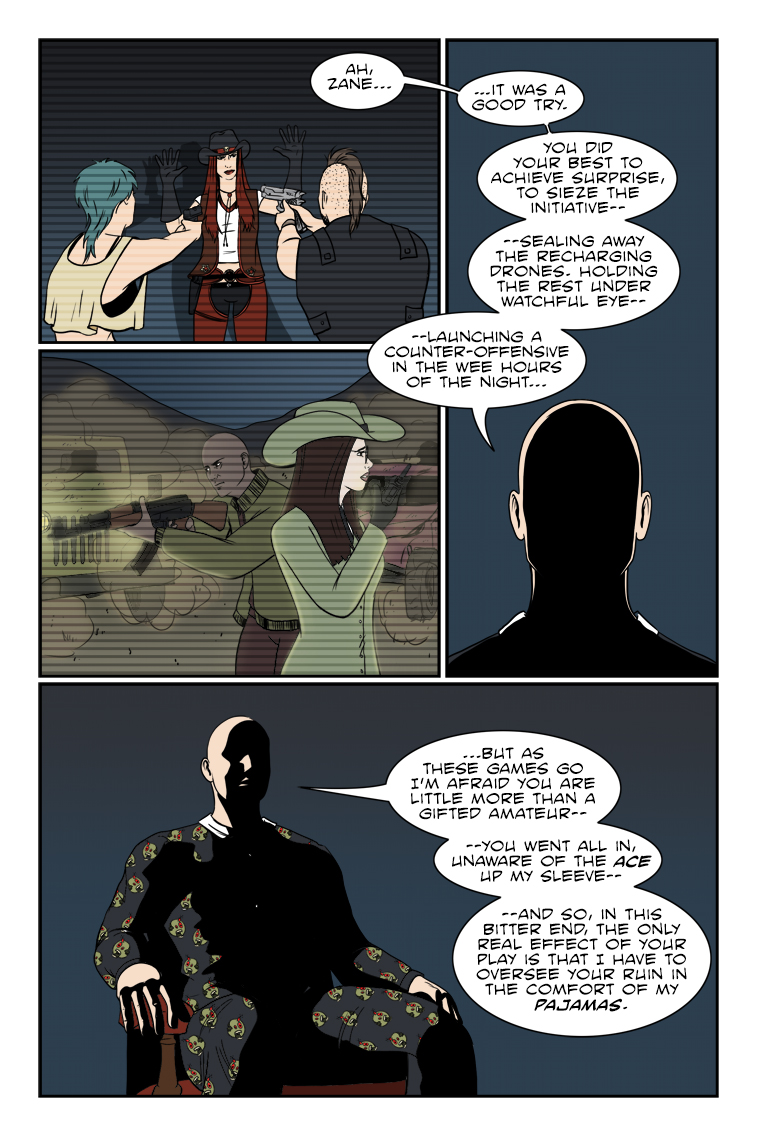
What would you call this? Armchair assassination? Merk-from-home?
Well, Suzie ain't dead (or undead) quite yet, so we'll just have to see if his gloating is justifiable.
Capturing the moment
In Understanding Comics, Scott McCloud talked about the concept of “closure” in relation to comics reading, which is more or less the idea of the audience filling in the blanks (or gutters) between drawn panels in order to complete the action. It reminds me of when I dabbled in doing simple Flash animations way back in the day where you’d draw a ball hanging in mid-air, then draw it partially squashed on the ground a little ways away, and then rounded in the air again a little further than that, and then you’d use a function to tell the program to make a bunch of the in-between pictures in order to complete the animation of the ball bouncing.
Comics leave the bouncing of the ball to your mind, and in a sense it’s the job of the writer/artist to program you properly so that you fill the in-betweens in a meaningful fashion. Related to this is the idea of allowing the spaces to exist, such as Sara Ryan discusses in her post on getting a robot to make a sandwich and how that applies to comics writing.
If you haven’t ever heard of the robot making a sandwich thing (and don’t want to check out her blog), the gist is an old thinkpiece where you’re supposed to instruct a robot to make you a sandwich. This robot has no AI to speak of and no knowledge other than that you provide to it, so the command “Make me a sandwich” is not going to work. Even going step-by-step through the whole process, people tend to omit certain things they take for granted, like how you would spread mayonnaise with the knife. Also did you tell it what type of knife, and where the knife is, and which end of the knife to use? As you’re probably getting the idea, the situation is a teaching tool for beginning programmers and the like on how you need to list out all necessary steps for an operation to run correctly and not assume anything is just “common knowledge” or “common sense”.
Now in her blog Ryan is using this to bring up the pitfall of newbie comics writers trying to show more than one action in the same panel. Your artist will understandably want to throttle you if your panel description were to say “Bill gets a knife out of the drawer, dips it in the mayonnaise and begins spreading it on his sandwich”. Similarly she talks about the pitfall of having a character display two wildly different emotions in the same panel, although that’s a case where we have deliberately cheated in the past, to what I think is fun effect. It’s good to know the rules, but following them all the time without exception can get pretty boring.
Anyhow, I don’t intend to retread her ground, I wanted to instead focus on the fact that humans aren’t robots and the successful comics creator is going to take full advantage of not having to show and explain every little step. Instead, it’s all about picking out the most important moment from an imagined series of them. I seem to recall McCloud using the example of someone getting into a car, and offering up several possibilities of showing them approaching the car, getting out their keys, opening the lock, opening the door, etc. etc. until they finally drive away. Even in a motion picture this sequence has the potential to be excrucriatingly irrelevant to the story, but McCloud aptly displays the insane waste of space it becomes in comics form (unless your story is all about mundane minutiae, I suppose).
So assuming the panel needs to be there at all, which moment is most important to the story? If the person forgot or lost their keys, the artist might best be served capturing them at the moment they are standing at the car door, fumbling in their pocket or purse. If it’s all about transition between areas, capture them as they’re climbing behind the wheel. The audience will fill in the rest, but they’ll have that “snapshot” to mold their perceptions around.
And for that matter, consider the matter of dialogue. If you took a comics image as a literal representation of life, people would be holding the same facial expressions and body poses for entire lengthy speeches. In the last panel of this page, Chuck is not leaned in towards the camera, frozen in place, for the all those words. How would he even enunciate properly without moving his mouth? The sandwich robot would not understand this, but a person hears Chuck’s voice in their head and imagines his mouth moving and his eyebrows waggling conspiratorially. What’s more, that little miracle happens without us even much thinking about it. We’re just wired that way, the same way we see people as excited and happy when we tell them we have a present for them rather than what they happen to look like in a freeze frame of that reaction.
Oh, the perils of the pause button. I mean, this is technically a legitimate moment of their reaction, something that literally happens and is gone again in the blink of an eye — but in a comic you’d be well advised to stay away from choosing it unless you want the audience molding their closure around “Holy crap is she stoned?”
You can’t and shouldn’t show the entire making of the sandwich. But choose wisely.
Calendar
BlueSky Latest Posts
Writer’s Blog Archives