It’s been a while, so let me ask: Did we get a reason for him to WANT Susie dead? Not to backseat, but if we didn’t, I’m worried were about to move into “Stupid Evil” territory. Now, stupid happens, don’t get me wrong. It’s not bad storytelling for that to be the case here.
You’ve just done a good job NOT having that be a driving factor, so the “Kill off the stars of my successful reality TV show.” seems shortsighted, otherwise. Oh, I guess I could be mistaken about the in-story reality TV show’s success. Like, if the company behind them is losing money, or they think a change in management at the ranch would make the whole thing more popular/profitable, then I can see the above scenario happening as well.
I REALLY think I’m just forgetting something important, but that I don’t have time to deep dive to remind me of, hence the comment. >_<
It certainly has been stretched out over quite a while, but there have definitely been hints from quite near the beginning that whoever is running the reality TV show definitely wants her dead.
Yeah it’s fair to not remember since it’s been a hot minute (many, many minutes) but if you feel like a refresher the most relevant bits would be the beginning of Episode 8 and the end of Episode 15. We haven’t explicitly spelled out exactly what The Exec means by his “side hustle” or who was on the other end of that phone call, though.
I’m hoping that when the whole thing is eventually available it will make sense, or at least enough sense to have hung this narrative on.
Otaku
Thanks for the replies, Deoxy and Clint. Yeah, I’d totally forgotten about those things. Good to know!
There’s still 3-5 people on her side that might be planning something. This guy is a megalomaniac with a god complex, so letting him think he’s the sharpest tool in the shed sets him up for a fall. Everything depends on those cameras, and I suspect their little stop over by the charging coffins had something to do with her actual plan, not the one the a-hole thinks it is.
Really enjoyed the opening of Zombie Ranch. I like the combination of the western setting with the zombie concept, it gives the story a really distinctive atmosphere. I’m a freelance illustrator and animator, and I’d be interested in seeing how some of these scenes could translate into motion, especially as a short animated teaser or character scene.
If you’re ever interested in something like that, you can reach me here:
Funny word in an industry sense, isn’t it? “Independence.” In the geekosphere of pop culture creation, it’s usually taken to mean that you are beholden to no overlords, no company or collective, that has a say over what you produce and how you produce it. I suppose it gets more complicated when you consider that there are definitely companies or collectives who you can technically surrender some or all of your independence to but those companies or collectives themselves are considered “independent.” Perhaps it just comes down to a matter of scale?
I think more important than scale is the mindset, though. Critical Role Productions, LLC makes millions of dollars every year for its founders, who are the cast members of Critical Role. But although they do run some aspects of their business carefully (as you’ll see when Matt Mercer cuts off any non-public domain song asides from the group before they reach the threshold of copyright lawsuit) they still feel in touch with their audience. The audience are still their customers. If they took any other ventures under their wing, it wouldn’t feel like a hostile takeover. They don’t see similar enterprises like Dimension 20 as competitors to be dominated but as fellow travelers to talk shop with and even cross-pollinate for promotion and fun.
There’s a point where that stops, and I’m not going to say it’s entirely a matter of independence because there are definitely some assholes out there in indie-land and not all of them fail. But I do believe that there’s a sharp divide that businesses hit where you can see a before and after, and that’s the public offering. The company is now on a stock exchange, or indirectly so because they were bought by a bigger fish that is. The shift is fundamentally the same, though… the consumer is no longer the customer. The consumer becomes a resource to be… let’s say “leveraged”… in the service of your new actual customers, the stockholders.
Don’t get me wrong, I’m not advocating the teardown of capitalism here, but it just feels like a built-in problem to me when full incorporation by design detaches a company from the end users. Now it’s all about the stock price and being able to show a constantly rising chart and it feels like no one really cares about the means of how you achieve that, just make it happen. That detachment, that ends-justifying-the-means mentality that turns people into statistics… it’s baked in, especially nowadays where people don’t seem to want to invest in companies and earn steady dividends so much as ride the waves of buying low and selling high to make as much money as possible as quickly as possible, then get out. What’s the company? What’s it creating? Who cares?
Well, there’s still wriggle room for creativity under these circumstances–I sure liked Andor and Disney is about as big a corporate overlord as it gets–but it feels like it’s in spite of the system rather than enabled by it, like the Eye of Sauron was looking elsewhere but once something like Frozen is a runaway hit you can bet Frozen 2 is going to be gone over with a fine-toothed comb by execs attempting to put quantifiable numbers on every aspect of human connection.
The detachment of incorporation affects everything, but in particular I feel it clashes with the creative arts where the human connection is everything. You can go by the numbers and there are certainly tried-and-true ways to manipulate the sort of emotional responses desired from a crowd, but in the end there’s still that nagging feeling because the ones at the top of the chain are very definitely not interested in telling a good story except as a by-product of getting them rich.
I mean at least it’s not a cigarette conglomerate, but ClearStream is undeniably my commentary on this situation and how that detachment can make even human life nothing more than numbers on a balance sheet. And although aspects of it are exaggerated–I doubt even a piece of work like Bobby Kotick sits in a dark room dramatically steepling his fingers–I’m glad that for all our faults, the only margins Dawn and I are truly concerned with have to do with page layouts.



9 thoughts on “558 – Cotton Clad Calamity”
Raznaak
Yup, he’s a bastard XD
Dr. Norman (not a real doctor)
Are those pajamas available in XXXL in the gift shop?
Otaku
It’s been a while, so let me ask: Did we get a reason for him to WANT Susie dead? Not to backseat, but if we didn’t, I’m worried were about to move into “Stupid Evil” territory. Now, stupid happens, don’t get me wrong. It’s not bad storytelling for that to be the case here.
You’ve just done a good job NOT having that be a driving factor, so the “Kill off the stars of my successful reality TV show.” seems shortsighted, otherwise. Oh, I guess I could be mistaken about the in-story reality TV show’s success. Like, if the company behind them is losing money, or they think a change in management at the ranch would make the whole thing more popular/profitable, then I can see the above scenario happening as well.
I REALLY think I’m just forgetting something important, but that I don’t have time to deep dive to remind me of, hence the comment. >_<
Deoxy
It certainly has been stretched out over quite a while, but there have definitely been hints from quite near the beginning that whoever is running the reality TV show definitely wants her dead.
But I certainly don’t recall any reason why.
Clint
Yeah it’s fair to not remember since it’s been a hot minute (many, many minutes) but if you feel like a refresher the most relevant bits would be the beginning of Episode 8 and the end of Episode 15. We haven’t explicitly spelled out exactly what The Exec means by his “side hustle” or who was on the other end of that phone call, though.
I’m hoping that when the whole thing is eventually available it will make sense, or at least enough sense to have hung this narrative on.
Otaku
Thanks for the replies, Deoxy and Clint. Yeah, I’d totally forgotten about those things. Good to know!
Evervigilant
Seems about time for the two people who aren’t there to make a surprise entrance as the ace Susie didn’t even know she had.
Scarsdale
There’s still 3-5 people on her side that might be planning something. This guy is a megalomaniac with a god complex, so letting him think he’s the sharpest tool in the shed sets him up for a fall. Everything depends on those cameras, and I suspect their little stop over by the charging coffins had something to do with her actual plan, not the one the a-hole thinks it is.
lyra
Really enjoyed the opening of Zombie Ranch. I like the combination of the western setting with the zombie concept, it gives the story a really distinctive atmosphere. I’m a freelance illustrator and animator, and I’d be interested in seeing how some of these scenes could translate into motion, especially as a short animated teaser or character scene.
If you’re ever interested in something like that, you can reach me here:
IG: eve_verse_
Email: [contact.lilaclines@gmail.com](mailto:contact.lilaclines@gmail.com)
Discord: Lyralilac_
Latest Comics
#40. 38 – Here Comes Trouble
64 Jul 28, 2010
#39. 37 – Different Views
61 Jul 14, 2010
#38. 36 – Horse With A Name
53 Jul 07, 2010
#37. 35 – Food For Thought
56 Jun 30, 2010
#36. 34 – The Unkindest Cut
59 Jun 23, 2010
#35. 33 – Farm Fresh
56 Jun 16, 2010
#34. 32 – Business Plans
57 Jun 02, 2010
#33. 31 – Desert Rose
54 May 26, 2010
#32. 30 – Silent Commentary
57 May 19, 2010
#31. 29 – Perils Of The Profession
50 May 12, 2010
#30. 28 – You Don’t Need A Body
57 May 05, 2010
#29. 27 – Executive Oversight
54 Apr 28, 2010
#28. 26 – Menace To Merchandise!
66 Apr 21, 2010
#27. 25 – Catastrophe To Commodity!
69 Apr 14, 2010
#26. 24 – When Advertisements Attack
72 Apr 07, 2010
#25. EPISODE TWO
55 Apr 06, 2010
#24. 23 – Day In The Death (END OF EPISODE 1)
54 Mar 17, 2010
#23. 22 – Simple Math
62 Mar 10, 2010
#22. 21 – In The Blood
64 Mar 03, 2010
#21. 20 – Man Down
60 Feb 24, 2010
Latest Chapters
Episode 22
Episode 21
Episode 20
Episode 19
Episode 18
Episode 17
558 – Cotton Clad Calamity
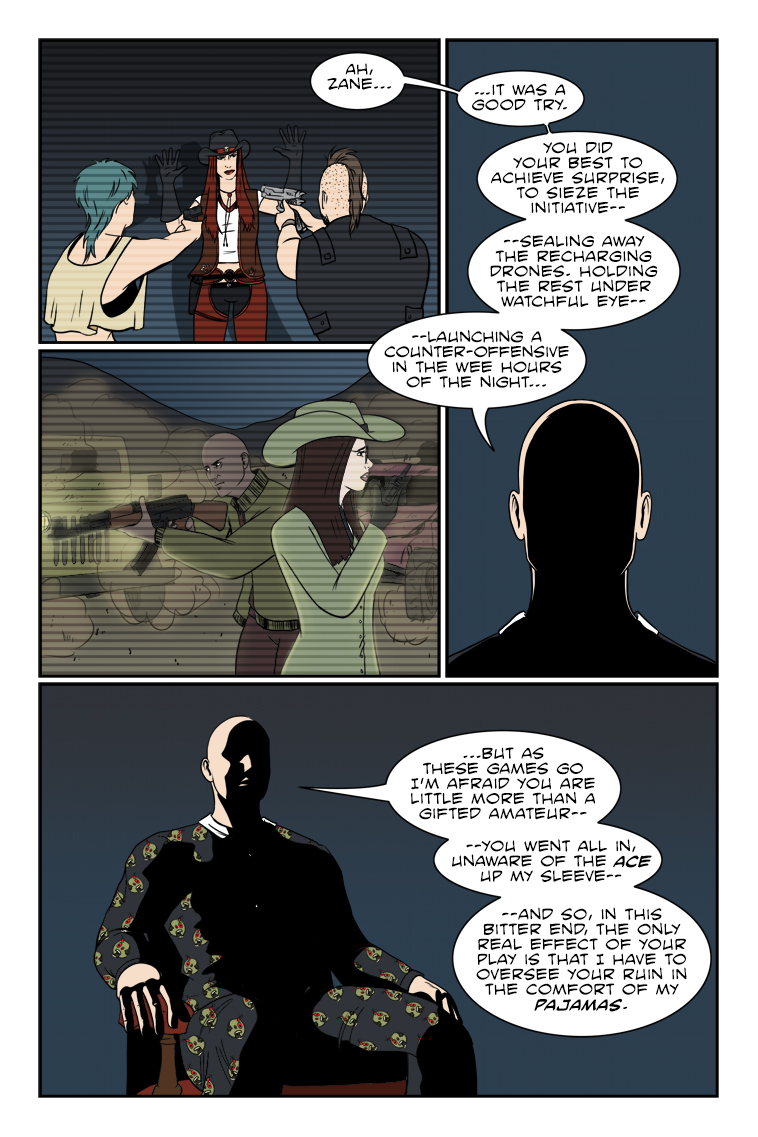
What would you call this? Armchair assassination? Merk-from-home?
Well, Suzie ain't dead (or undead) quite yet, so we'll just have to see if his gloating is justifiable.
Independent thoughts…
Funny word in an industry sense, isn’t it? “Independence.” In the geekosphere of pop culture creation, it’s usually taken to mean that you are beholden to no overlords, no company or collective, that has a say over what you produce and how you produce it. I suppose it gets more complicated when you consider that there are definitely companies or collectives who you can technically surrender some or all of your independence to but those companies or collectives themselves are considered “independent.” Perhaps it just comes down to a matter of scale?
I think more important than scale is the mindset, though. Critical Role Productions, LLC makes millions of dollars every year for its founders, who are the cast members of Critical Role. But although they do run some aspects of their business carefully (as you’ll see when Matt Mercer cuts off any non-public domain song asides from the group before they reach the threshold of copyright lawsuit) they still feel in touch with their audience. The audience are still their customers. If they took any other ventures under their wing, it wouldn’t feel like a hostile takeover. They don’t see similar enterprises like Dimension 20 as competitors to be dominated but as fellow travelers to talk shop with and even cross-pollinate for promotion and fun.
There’s a point where that stops, and I’m not going to say it’s entirely a matter of independence because there are definitely some assholes out there in indie-land and not all of them fail. But I do believe that there’s a sharp divide that businesses hit where you can see a before and after, and that’s the public offering. The company is now on a stock exchange, or indirectly so because they were bought by a bigger fish that is. The shift is fundamentally the same, though… the consumer is no longer the customer. The consumer becomes a resource to be… let’s say “leveraged”… in the service of your new actual customers, the stockholders.
Don’t get me wrong, I’m not advocating the teardown of capitalism here, but it just feels like a built-in problem to me when full incorporation by design detaches a company from the end users. Now it’s all about the stock price and being able to show a constantly rising chart and it feels like no one really cares about the means of how you achieve that, just make it happen. That detachment, that ends-justifying-the-means mentality that turns people into statistics… it’s baked in, especially nowadays where people don’t seem to want to invest in companies and earn steady dividends so much as ride the waves of buying low and selling high to make as much money as possible as quickly as possible, then get out. What’s the company? What’s it creating? Who cares?
Well, there’s still wriggle room for creativity under these circumstances–I sure liked Andor and Disney is about as big a corporate overlord as it gets–but it feels like it’s in spite of the system rather than enabled by it, like the Eye of Sauron was looking elsewhere but once something like Frozen is a runaway hit you can bet Frozen 2 is going to be gone over with a fine-toothed comb by execs attempting to put quantifiable numbers on every aspect of human connection.
The detachment of incorporation affects everything, but in particular I feel it clashes with the creative arts where the human connection is everything. You can go by the numbers and there are certainly tried-and-true ways to manipulate the sort of emotional responses desired from a crowd, but in the end there’s still that nagging feeling because the ones at the top of the chain are very definitely not interested in telling a good story except as a by-product of getting them rich.
I mean at least it’s not a cigarette conglomerate, but ClearStream is undeniably my commentary on this situation and how that detachment can make even human life nothing more than numbers on a balance sheet. And although aspects of it are exaggerated–I doubt even a piece of work like Bobby Kotick sits in a dark room dramatically steepling his fingers–I’m glad that for all our faults, the only margins Dawn and I are truly concerned with have to do with page layouts.
Calendar
BlueSky Latest Posts
Writer’s Blog Archives