It’s been a while, so let me ask: Did we get a reason for him to WANT Susie dead? Not to backseat, but if we didn’t, I’m worried were about to move into “Stupid Evil” territory. Now, stupid happens, don’t get me wrong. It’s not bad storytelling for that to be the case here.
You’ve just done a good job NOT having that be a driving factor, so the “Kill off the stars of my successful reality TV show.” seems shortsighted, otherwise. Oh, I guess I could be mistaken about the in-story reality TV show’s success. Like, if the company behind them is losing money, or they think a change in management at the ranch would make the whole thing more popular/profitable, then I can see the above scenario happening as well.
I REALLY think I’m just forgetting something important, but that I don’t have time to deep dive to remind me of, hence the comment. >_<
It certainly has been stretched out over quite a while, but there have definitely been hints from quite near the beginning that whoever is running the reality TV show definitely wants her dead.
Yeah it’s fair to not remember since it’s been a hot minute (many, many minutes) but if you feel like a refresher the most relevant bits would be the beginning of Episode 8 and the end of Episode 15. We haven’t explicitly spelled out exactly what The Exec means by his “side hustle” or who was on the other end of that phone call, though.
I’m hoping that when the whole thing is eventually available it will make sense, or at least enough sense to have hung this narrative on.
Otaku
Thanks for the replies, Deoxy and Clint. Yeah, I’d totally forgotten about those things. Good to know!
There’s still 3-5 people on her side that might be planning something. This guy is a megalomaniac with a god complex, so letting him think he’s the sharpest tool in the shed sets him up for a fall. Everything depends on those cameras, and I suspect their little stop over by the charging coffins had something to do with her actual plan, not the one the a-hole thinks it is.
Really enjoyed the opening of Zombie Ranch. I like the combination of the western setting with the zombie concept, it gives the story a really distinctive atmosphere. I’m a freelance illustrator and animator, and I’d be interested in seeing how some of these scenes could translate into motion, especially as a short animated teaser or character scene.
If you’re ever interested in something like that, you can reach me here:
A couple of weeks ago I penned a piece on what I felt were my basics in crafting a good character. But what exactly is a good character? Or a strong character? Aren’t these adjectives bringing connotations with them that apply unnecessary baggage to the concept? Villains can be good characters. Weaklings can be strong characters. Here we are, writers who make a living (or at least make a studied hobby) of expressing ourselves through words, and yet after all this time, what the hell, exactly, are we even talking about?
I suppose at the core there’s that idea I touched on of a character being somehow relatable to the audience. There’s some facet we recognize in ourselves or in others of our experience that we can cling onto, core elements and archetypes of the human condition. Yes, I just used the phrase “the human condition” unironically, feel free to virtually punch me in the face. Ow. Virtual pain. But listen, it’s not that far removed a concept from when I was studying acting. As an actor your task is bringing a character written by someone else to a semblance of life, but no one requires you to have personal experience of, say, murdering someone, much less committing suicide. Putting a successful suicide on your resume seems like something that would be a detriment to your career, at least in this world.
So you have to fudge things. To a certain extent personal experience may help with authenticity, but more often than not, you’re going to be searching within yourself for the part of your own experience that’s closest to the situation. You find that angry part of you, that scared part, that grieving part, and coax it forwards. As weird as it sounds, you have methods like remembering the shattering grief you felt when your favorite pet died and using that as the gateway to the tears you’ll sob every night as your Lear staggers under the weight of his dear Cordelia’s corpse.
And if you do it right, the audience will connect with that. Again the chances are that most of them wouldn’t have the personal experience of losing a child, especially under such horrible circumstances, but they can empathize with the situation. In fact it’s exactly this sort of empathy which drags us into stories and makes us crave them, safely experiencing triumphs and tragedies through a vicarious vector.
I once compared writing to being a director wrangling (at times ornery) actors through the story. But another truth is that ultimately, you represent both director and actor, and the “strength” of your characters will depend at least in part on your ability to relate to them. And through them.



9 thoughts on “558 – Cotton Clad Calamity”
Raznaak
Yup, he’s a bastard XD
Dr. Norman (not a real doctor)
Are those pajamas available in XXXL in the gift shop?
Otaku
It’s been a while, so let me ask: Did we get a reason for him to WANT Susie dead? Not to backseat, but if we didn’t, I’m worried were about to move into “Stupid Evil” territory. Now, stupid happens, don’t get me wrong. It’s not bad storytelling for that to be the case here.
You’ve just done a good job NOT having that be a driving factor, so the “Kill off the stars of my successful reality TV show.” seems shortsighted, otherwise. Oh, I guess I could be mistaken about the in-story reality TV show’s success. Like, if the company behind them is losing money, or they think a change in management at the ranch would make the whole thing more popular/profitable, then I can see the above scenario happening as well.
I REALLY think I’m just forgetting something important, but that I don’t have time to deep dive to remind me of, hence the comment. >_<
Deoxy
It certainly has been stretched out over quite a while, but there have definitely been hints from quite near the beginning that whoever is running the reality TV show definitely wants her dead.
But I certainly don’t recall any reason why.
Clint
Yeah it’s fair to not remember since it’s been a hot minute (many, many minutes) but if you feel like a refresher the most relevant bits would be the beginning of Episode 8 and the end of Episode 15. We haven’t explicitly spelled out exactly what The Exec means by his “side hustle” or who was on the other end of that phone call, though.
I’m hoping that when the whole thing is eventually available it will make sense, or at least enough sense to have hung this narrative on.
Otaku
Thanks for the replies, Deoxy and Clint. Yeah, I’d totally forgotten about those things. Good to know!
Evervigilant
Seems about time for the two people who aren’t there to make a surprise entrance as the ace Susie didn’t even know she had.
Scarsdale
There’s still 3-5 people on her side that might be planning something. This guy is a megalomaniac with a god complex, so letting him think he’s the sharpest tool in the shed sets him up for a fall. Everything depends on those cameras, and I suspect their little stop over by the charging coffins had something to do with her actual plan, not the one the a-hole thinks it is.
lyra
Really enjoyed the opening of Zombie Ranch. I like the combination of the western setting with the zombie concept, it gives the story a really distinctive atmosphere. I’m a freelance illustrator and animator, and I’d be interested in seeing how some of these scenes could translate into motion, especially as a short animated teaser or character scene.
If you’re ever interested in something like that, you can reach me here:
IG: eve_verse_
Email: [contact.lilaclines@gmail.com](mailto:contact.lilaclines@gmail.com)
Discord: Lyralilac_
Latest Comics
#240. 230 – Undeath And Taxes
18 Oct 29, 2014
#239. 229 – Rancher’s Answer
18 Oct 22, 2014
#238. 228 – Unintentional Roughness
19 Oct 15, 2014
#237. 227 – Flyaway Blues
21 Oct 08, 2014
#236. 226 – The Sky’s The Limit
20 Oct 01, 2014
#235. 225 – Transportation Breakdown
55 Sep 24, 2014
#234. 224 – Time To Get High
53 Sep 17, 2014
#233. EPISODE TEN
59 Sep 15, 2014
#232. 223 – Surrounded (END OF EPISODE 9)
51 Aug 27, 2014
#231. 222 – Network Overhead
58 Aug 20, 2014
#230. 221 – This Hat Remembers Him
14 Aug 13, 2014
#229. 220 – Cope Springs Eternal
19 Aug 06, 2014
#228. 219 – Rejection Notice
21 Jul 16, 2014
#227. 218 – Property And Loss
33 Jul 09, 2014
#226. 217 – Out Of Focus
32 Jul 02, 2014
#225. 216 – Red Eyes At Mourning
18 Jun 25, 2014
#224. 215 – Grave Matters
16 Jun 18, 2014
#223. 214 – A Moment With Suzie, Part 2
13 Jun 11, 2014
#222. 213 – Second Chance Offer
21 Jun 04, 2014
#221. 212 – Frank Talk
16 May 28, 2014
Latest Chapters
Episode 22
Episode 21
Episode 20
Episode 19
Episode 18
Episode 17
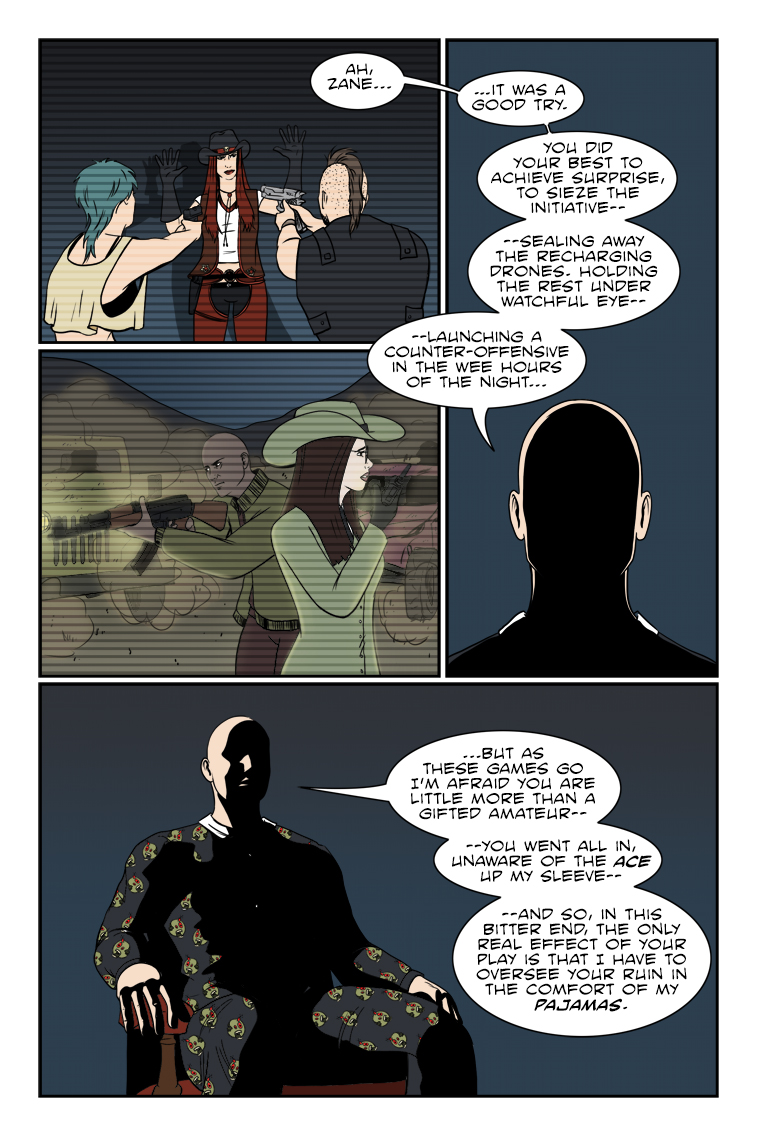
558 – Cotton Clad Calamity
What would you call this? Armchair assassination? Merk-from-home?
Well, Suzie ain't dead (or undead) quite yet, so we'll just have to see if his gloating is justifiable.
Can you relate?
A couple of weeks ago I penned a piece on what I felt were my basics in crafting a good character. But what exactly is a good character? Or a strong character? Aren’t these adjectives bringing connotations with them that apply unnecessary baggage to the concept? Villains can be good characters. Weaklings can be strong characters. Here we are, writers who make a living (or at least make a studied hobby) of expressing ourselves through words, and yet after all this time, what the hell, exactly, are we even talking about?
I suppose at the core there’s that idea I touched on of a character being somehow relatable to the audience. There’s some facet we recognize in ourselves or in others of our experience that we can cling onto, core elements and archetypes of the human condition. Yes, I just used the phrase “the human condition” unironically, feel free to virtually punch me in the face. Ow. Virtual pain. But listen, it’s not that far removed a concept from when I was studying acting. As an actor your task is bringing a character written by someone else to a semblance of life, but no one requires you to have personal experience of, say, murdering someone, much less committing suicide. Putting a successful suicide on your resume seems like something that would be a detriment to your career, at least in this world.
So you have to fudge things. To a certain extent personal experience may help with authenticity, but more often than not, you’re going to be searching within yourself for the part of your own experience that’s closest to the situation. You find that angry part of you, that scared part, that grieving part, and coax it forwards. As weird as it sounds, you have methods like remembering the shattering grief you felt when your favorite pet died and using that as the gateway to the tears you’ll sob every night as your Lear staggers under the weight of his dear Cordelia’s corpse.
And if you do it right, the audience will connect with that. Again the chances are that most of them wouldn’t have the personal experience of losing a child, especially under such horrible circumstances, but they can empathize with the situation. In fact it’s exactly this sort of empathy which drags us into stories and makes us crave them, safely experiencing triumphs and tragedies through a vicarious vector.
I once compared writing to being a director wrangling (at times ornery) actors through the story. But another truth is that ultimately, you represent both director and actor, and the “strength” of your characters will depend at least in part on your ability to relate to them. And through them.
Calendar
BlueSky Latest Posts
Writer’s Blog Archives