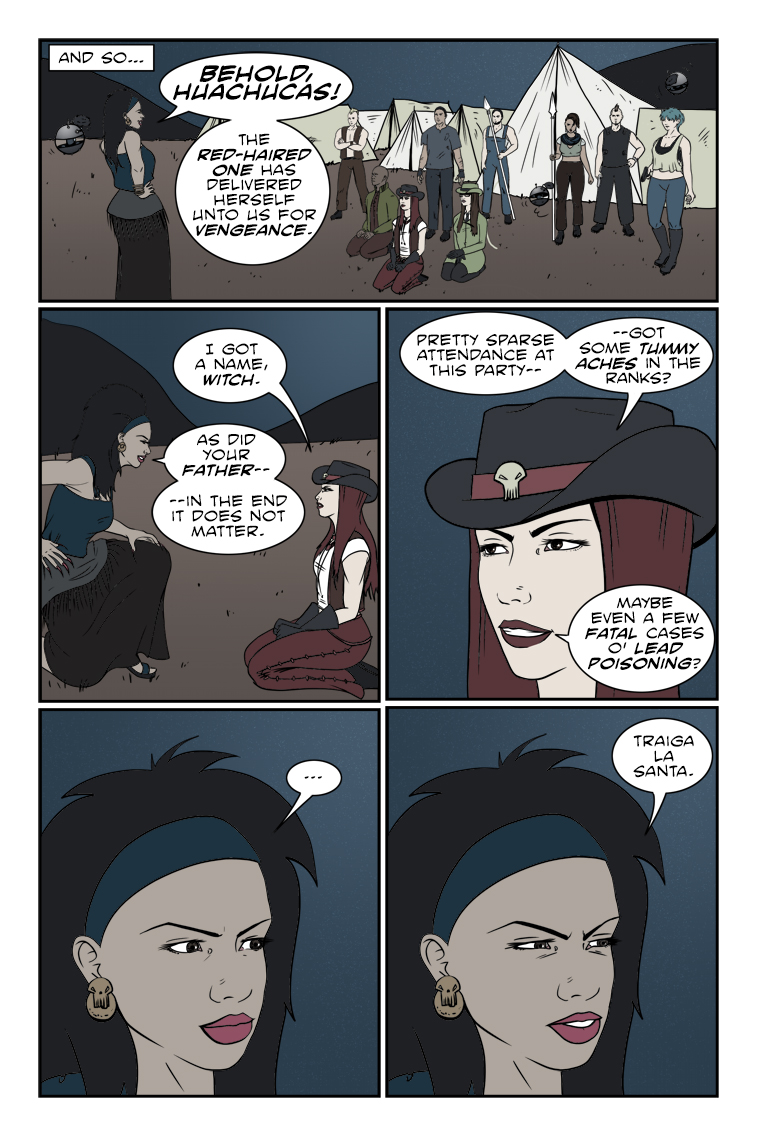
Oh I have a hunch she was expecting this, and why they robbed the “coffins” for the floating cams first. Everyone is going to be freaked out when the cams go haywire and then the cavalry will show up.
This link may not work for you without an InkOutbreak account, but basically Savannah Houston-McIntyre, writer of the webcomic Amya, was opening a discussion on the forums about creating strong, iconic, and most of all relatable characters, and the techniques people use for doing so.
When first putting together Zombie Ranch I wanted a lot of classic Western fiction influence, so I tended to start a certain archetypal template and then flesh things out from there. For example, when coming up with our lead’s mannerisms and attitudes, I took a lot of inspiration from the classic cowboy roles of John Wayne. For a drifter character of uncertain morals, I couldn’t have asked for a better model than Eli Wallach’s portrayal of Tuco from The Good, The Bad, and the Ugly.
That gave me a headstart on being iconic, but icons will only take you so far if there’s nothing beyond the surface. On the other hand, it doesn’t matter how much back story you have for a character if you can’t communicate it effectively to your readers, which includes having the restraint to *not* communicate the back story if it’s not appropriate for the narrative. Han Solo didn’t sit down at the Mos Eisley table and immediately regale Luke and Ben about his days as a Lieutenant in the Imperial Navy… it wasn’t relevant and likely would have left the audience cold. In fact, it never comes up over the course of the movies, except for Han occasionally having some strangely specific knowledge of Imperial procedures. Anyhow, we’ve been over this.
When writing from anything other than a first person viewpoint (and sometimes even then), I still think when you’re introducing a character it helps to mimic the natural flow of how we meet and get to know people in our real lives… we start with stereotypical surface impressions, and only later, over a period of time, do we get potentially get past that and learn how correct (or incorrect) our assumptions might be. I remember the first time I watched Raiders of the Lost Ark as a kid, when no one knew who Indiana Jones was, and in the opening minutes this grizzled thug attacks a guy with a bullwhip and looms out of the jungle darkness with a scowl. It was the introduction a villain would have, but then you find out, nope, that’s our hero! Then as we go along we keep peeling back the onion of who this guy is. Ooh, he’s pretty good at this. Oops, nope, now he’s running for his life. Hates snakes? Funny. Whoa, look how clean-cut he is now, and teaching a college class?!
Nowhere in all this do they stop to spell things out, but the surprises also don’t seem out of place, and they keep hooking your interest by challenging your assumptions, like that mousy co-worker you’ve known for three years and suddenly find out they used to be a professional singer. “You sing? I didn’t know you sing!” “Well, we work in a post office. it never came up.” Dr. Jones doesn’t just randomly start shouting that he hates snakes, it comes up because his pilot’s pet snake is in the (motherf’in) plane. And while it’s played for a bit of random laughs, later on it becomes really important when we reach the Well of Souls.
I know it’s not technically a comic, but seriously, look at what a movie like Raiders of the Lost Ark accomplishes without resorting to a single flashback sequence, even though there’s obviously a ton of history between certain characters. We know all we need to know from just watching them in the present, and it works, and we grow to love or hate them accordingly. We don’t need to see every encounter that ever happened between Indy and Belloq, we only need to know that “…there is nothing you can possess which I cannot take away“.
So how does all this rambling come back to the issue of strong, relatable characters? Well, I think it’s all about the basics, and the basics are about people, and we more readily perceive fictional creations as people if they are behaving in ways somehow familiar to us, even if their surroundings are bizarre. “People” doesn’t necessarily have to mean “human” in fiction, but it’s a tough job writing creatures with a truly alien mindset. Usually aliens (including non-human fantasy races) just end up being a certain aspect of human nature taken to extremes, but still recognizable. Even our notions of Gods still tend to have human forms and human motivations. We can’t get away from it, and I’m not sure we should even try, because ultimately I think storytelling boils down to humanity wanting to hear about, and reflect upon, Ourselves.



4 thoughts on “559 – Words To Die By”
Scarsdale
Ha! I love the “o` lead poisoning” comment, I’ve used it to run kids off there were trying to set our hay bales on fire 😉
Scarsdale
Never mind that my shotgun had rock salt loads 😀
ConcordBob
Finally the two female leads are face-to-face! Now if Rosa can swoop in to save Suzie….
Scarsdale
Oh I have a hunch she was expecting this, and why they robbed the “coffins” for the floating cams first. Everyone is going to be freaked out when the cams go haywire and then the cavalry will show up.
Latest Comics
#1. EPISODE ONE
68 Sep 24, 2009
Latest Chapters
Episode 22
Episode 21
Episode 20
Episode 19
Episode 18
Episode 17
559 – Words To Die By
In Suzie's defense, it's not like they were going to get out of this by being nice.
The basics of character
This link may not work for you without an InkOutbreak account, but basically Savannah Houston-McIntyre, writer of the webcomic Amya, was opening a discussion on the forums about creating strong, iconic, and most of all relatable characters, and the techniques people use for doing so.
I got about seven thick paragraphs into my response before figuring it would be better for everyone if I just made it a blog entry, like the tumblr post she made that inspired her to ask around. So here it is.
When first putting together Zombie Ranch I wanted a lot of classic Western fiction influence, so I tended to start a certain archetypal template and then flesh things out from there. For example, when coming up with our lead’s mannerisms and attitudes, I took a lot of inspiration from the classic cowboy roles of John Wayne. For a drifter character of uncertain morals, I couldn’t have asked for a better model than Eli Wallach’s portrayal of Tuco from The Good, The Bad, and the Ugly.
That gave me a headstart on being iconic, but icons will only take you so far if there’s nothing beyond the surface. On the other hand, it doesn’t matter how much back story you have for a character if you can’t communicate it effectively to your readers, which includes having the restraint to *not* communicate the back story if it’s not appropriate for the narrative. Han Solo didn’t sit down at the Mos Eisley table and immediately regale Luke and Ben about his days as a Lieutenant in the Imperial Navy… it wasn’t relevant and likely would have left the audience cold. In fact, it never comes up over the course of the movies, except for Han occasionally having some strangely specific knowledge of Imperial procedures. Anyhow, we’ve been over this.
When writing from anything other than a first person viewpoint (and sometimes even then), I still think when you’re introducing a character it helps to mimic the natural flow of how we meet and get to know people in our real lives… we start with stereotypical surface impressions, and only later, over a period of time, do we get potentially get past that and learn how correct (or incorrect) our assumptions might be. I remember the first time I watched Raiders of the Lost Ark as a kid, when no one knew who Indiana Jones was, and in the opening minutes this grizzled thug attacks a guy with a bullwhip and looms out of the jungle darkness with a scowl. It was the introduction a villain would have, but then you find out, nope, that’s our hero! Then as we go along we keep peeling back the onion of who this guy is. Ooh, he’s pretty good at this. Oops, nope, now he’s running for his life. Hates snakes? Funny. Whoa, look how clean-cut he is now, and teaching a college class?!
Nowhere in all this do they stop to spell things out, but the surprises also don’t seem out of place, and they keep hooking your interest by challenging your assumptions, like that mousy co-worker you’ve known for three years and suddenly find out they used to be a professional singer. “You sing? I didn’t know you sing!” “Well, we work in a post office. it never came up.” Dr. Jones doesn’t just randomly start shouting that he hates snakes, it comes up because his pilot’s pet snake is in the (motherf’in) plane. And while it’s played for a bit of random laughs, later on it becomes really important when we reach the Well of Souls.
I know it’s not technically a comic, but seriously, look at what a movie like Raiders of the Lost Ark accomplishes without resorting to a single flashback sequence, even though there’s obviously a ton of history between certain characters. We know all we need to know from just watching them in the present, and it works, and we grow to love or hate them accordingly. We don’t need to see every encounter that ever happened between Indy and Belloq, we only need to know that “…there is nothing you can possess which I cannot take away“.
So how does all this rambling come back to the issue of strong, relatable characters? Well, I think it’s all about the basics, and the basics are about people, and we more readily perceive fictional creations as people if they are behaving in ways somehow familiar to us, even if their surroundings are bizarre. “People” doesn’t necessarily have to mean “human” in fiction, but it’s a tough job writing creatures with a truly alien mindset. Usually aliens (including non-human fantasy races) just end up being a certain aspect of human nature taken to extremes, but still recognizable. Even our notions of Gods still tend to have human forms and human motivations. We can’t get away from it, and I’m not sure we should even try, because ultimately I think storytelling boils down to humanity wanting to hear about, and reflect upon, Ourselves.
Whew. See why I decided to take this to the blog?
Calendar
BlueSky Latest Posts
Writer’s Blog Archives